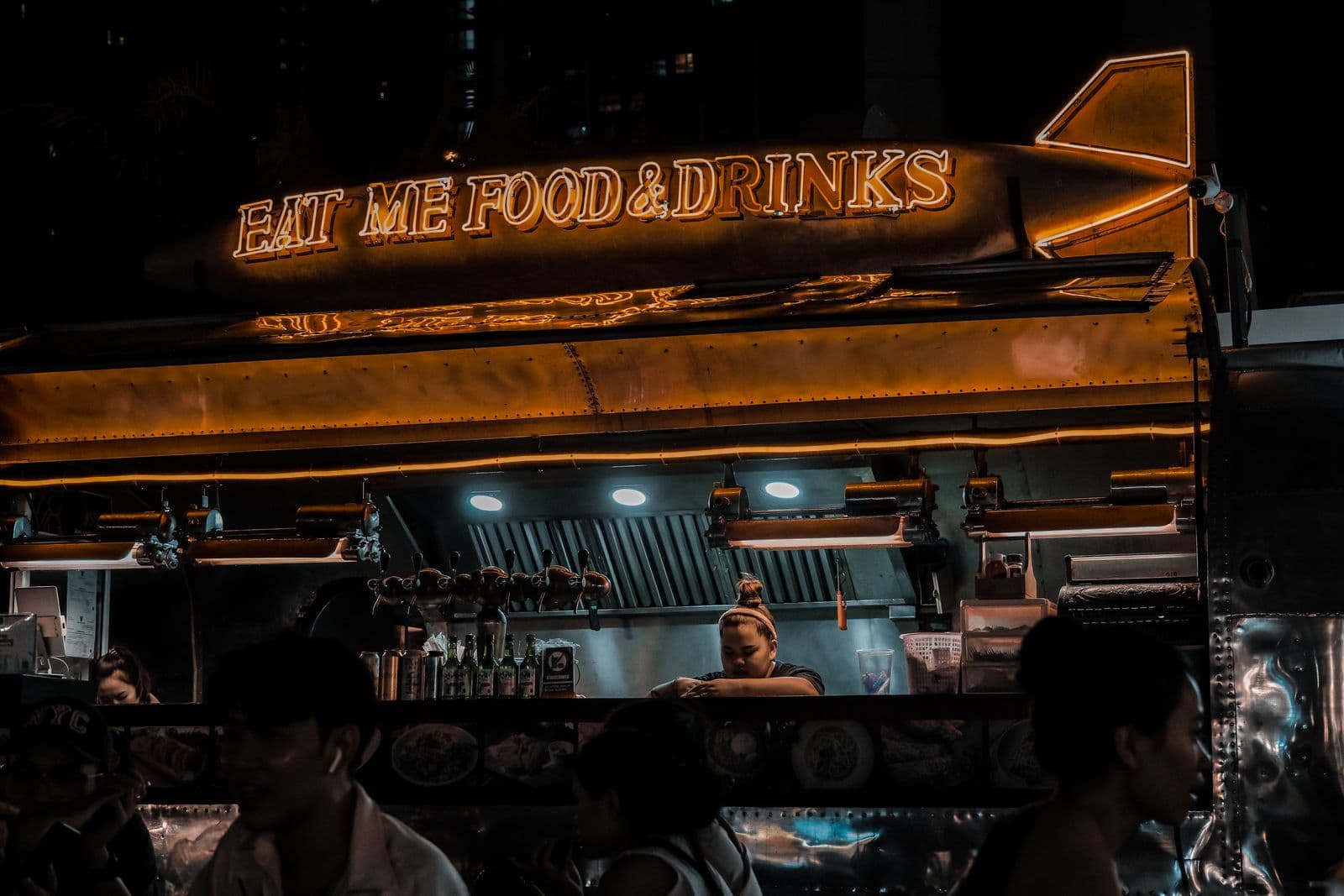
A breakdown on the way to a wedding costs far more than a service. Keep a log for the vehicle, the generator, gas appliances, fridges and fryers: when each was last serviced, who did it, and when it is next due. Eventifood's Pro Max plan stores service records for each vehicle.
Food truck business questions, answered
Software, costs, profit, marketing and growth — straight answers and step-by-step guides for UK food truck owners and anyone thinking of starting one.
Jump to a question
Choosing food truck software
- Best POS system for food trucks: what should I look for?
- How much does food truck software actually cost?
- Free vs paid POS systems for food trucks: which is right for me?
- Starting a food truck business: what software do I actually need?
- Food truck payment processing: which system is fastest?
- How do I handle multiple food truck terminals and equipment?
- Scaling a food truck business: what software supports growth?
Running the day with software
- Menu management software for food trucks: how do I change items quickly?
- What are the best inventory management tools for food trucks?
- Food truck reservation system: can customers book ahead?
- Food truck operating hours: how do I decide my schedule?
- Real-time GPS tracking for mobile food trucks: do I need it?
- Food truck scheduling software: how do I keep routes organised?
- Employee scheduling for food trucks: what is a simple solution?
- Food truck weather contingency planning: tips and tools
Money, admin and compliance
- Food truck analytics: what numbers actually matter?
- What are the best financial tracking tools for food truck owners?
- What is the best accounting software for food truck businesses?
- How do I track food truck permits, licences and certificates?
- Food truck catering contracts: what should they cover?
- How much revenue can a food truck generate?
- What food truck financing and loans are available in the UK?
- What insurance does a food truck need?
- Do I need food safety compliance software?
- How do food truck regulations vary by location?
- How should I track equipment maintenance?
- How do I manage food truck fuel costs?
- How do I manage supplier relationships?
Customers and marketing
- Food truck customer management: how do I build a loyalty programme?
- What are the best marketing tools for food truck owners?
- Food truck social media management: which apps save time?
- What are the best email tools for food truck marketing?
- Food truck customer data: how do I collect and use it?
- Customer survey questions for food trucks: what should I ask?
- What makes a food truck popular with customers?
- How do I attract more customers to a food truck?
- What makes a food truck stand out from competitors?
- How do I build a food truck brand?
- What are good conversation starters with customers at a food truck?
- How important are staff and customer service on a food truck?
Catering and events
Starting and growing a food truck
- Can you run a food truck part-time?
- Starting a food truck side business: what are the first steps and tools?
- Multi-location food truck management: how do I run more than one?
- Mobile food trailer vs food truck: which scales better?
- How do I expand a brick-and-mortar restaurant with a food truck?
- Can I connect my food truck to food delivery apps?
- Which food truck tasks are worth automating?
- What seasonal strategies work for food trucks?
Money, menus and vans
- Can you make good money running a food truck?
- What type of food truck makes the most money?
- What are the most profitable items to sell from a food truck?
- What food truck menu ideas sell well?
- How should a food truck handle vegan, gluten-free and allergy requirements?
- How much does a food truck cost to buy or start?
- What's the best type of van for starting a food truck business?
- Can you rent a food truck just to cook out of?
Choosing food truck software
- Best POS system for food trucks: what should I look for?
The best food truck POS is the one that keeps the queue moving. Judge any system on these points:
- 1Speed at the hatch: how many seconds does one order take, start to finish?
- 2Mobile ordering: can customers order and pay on their own phone while they queue?
- 3Works on hardware you already own — a phone, tablet or laptop — rather than a locked-in terminal.
- 4A kitchen screen, so orders reach the cook without shouting or paper tickets.
- 5Pricing that suits seasonal trading: no large monthly fee in the months you are not out.
- 6Quick menu edits and a sold-out switch you can flip mid-service.
Eventifood is built around the first point: customers scan your QR code, order and pay by card on their phone, and the order lands on your kitchen board. It runs in a browser, so there is nothing to install.
- How much does food truck software actually cost?
UK food truck software is usually priced one of three ways: a monthly subscription (commonly £20 to £80 a month per device), a percentage of each sale, or a free app that makes its money on card processing fees. On top of that you pay card processing — typically around 1.5% to 2.5% per transaction — and sometimes hardware. Eventifood starts free: no monthly fee on the pay-as-you-go plans, a platform fee of 1% to 3% per transaction depending on the plan you choose, plus card processing, and nothing at all in a month you are not trading. Monthly plans with no platform fee are available for busier vans. The plans differ in what they include, so compare them before you choose.
- Free vs paid POS systems for food trucks: which is right for me?
A free or pay-as-you-go system suits a new, part-time or seasonal van, because you only pay when you trade. A monthly plan becomes cheaper once your card takings are steady and high enough that a percentage fee costs more than the subscription.
- 1Estimate your monthly card takings in a typical busy month.
- 2Work out what a percentage-based plan would cost at that level.
- 3Compare it with the monthly fee of the paid plan, plus any hardware.
- 4Choose the cheaper one for your busy months — and check what it costs in your quiet ones.
- Starting a food truck business: what software do I actually need?
Less than you might think. On day one you need four things:
- 1A way to take card payments — mobile ordering or a card reader.
- 2A menu you can change quickly, with allergen information.
- 3A simple way to track takings and costs for your tax return.
- 4A social media account to tell people where you are.
Everything else — loyalty, analytics, rotas, stock control — can wait until you know you need it. Eventifood covers the first two from a free account, and adds analytics and full bookkeeping on its Pro and Pro Max plans.
- Food truck payment processing: which system is fastest?
The fastest payment is one that happens before the customer reaches the hatch. With QR ordering, customers pay on their own phone while they queue, so at the hatch they only collect. Of payments taken at the hatch, contactless cards and phone wallets are fastest; chip and PIN and cash are slowest.
- How do I handle multiple food truck terminals and equipment?
Keep the kit as simple as possible and make every device replaceable.
- 1Use browser-based software, so any tablet or phone can stand in if one breaks.
- 2Give each device a single job — for example, one screen for the kitchen, one for taking orders.
- 3Keep a power bank and spare charging cables on board, and label them.
- 4Use a mobile hotspot with a backup SIM from a different network in case one network is weak on site.
- 5Write the logins down and keep them somewhere safe off the van.
Eventifood's kitchen board runs in a web browser, so any tablet, laptop or Raspberry Pi with a screen will do.
- Scaling a food truck business: what software supports growth?
As you grow, the jobs that were easy on one van become hard across several. Put these in place before the second van:
- 1Online ordering, so each extra van does not need another person taking orders.
- 2Sales analytics, so you can see which van, site and menu item makes money.
- 3A bookings diary for events and the vans and staff assigned to them.
- 4Staff logins, so team members can run a van without your password.
- 5Bookkeeping that exports to your accountant's software.
Eventifood includes online ordering on every plan, adds analytics and staff logins on Pro, and a bookings diary and finance exports on Pro Max.
Running the day with software
- What are the best inventory management tools for food trucks?
For most vans, inventory means knowing what went out in the morning and what came back. A spreadsheet works to begin with. The habit matters more than the tool:
- 1Record your starting stock of key items before each service.
- 2Record wastage — what was thrown away and why — at the end.
- 3Compare with sales to see what you over-prepped.
- 4Adjust the next order to your suppliers accordingly.
Eventifood's wastage tracking (every plan) and stock control (Pro and above) record starting quantities and waste per day, so you can see what each service really cost.
- Food truck reservation system: can customers book ahead?
Yes — pre-orders with collection times cut queues at your busiest moments. Customers choose a slot, pay in advance, and collect without waiting. Cap how many orders each slot takes so the kitchen is never overwhelmed. Eventifood supports collection slots on the day, with a limit on orders per slot.
- Food truck operating hours: how do I decide my schedule?
Trade when your customers are hungry and nearby — not when it is convenient.
- 1List your candidate pitches and when people are actually there: lunch at offices, evenings at pubs, weekends at markets.
- 2Trial each slot for three or four weeks before judging it.
- 3Track takings per hour for each slot, not just per day.
- 4Drop the weakest slot and replace it with a new trial.
- 5Publish your hours everywhere, and stick to them — reliability builds regulars.
In Eventifood you can set opening hours, and pause orders with one tap when the kitchen gets overloaded.
- Real-time GPS tracking for mobile food trucks: do I need it?
Customers do not need to watch your van drive — they need to know exactly where it is parked, and when you are open. GPS location at the pitch does that. With Eventifood:
- 1Arrive at your pitch and open the Location page in your seller account.
- 2Tap "Use GPS" — your phone places your pin on the map at your exact position.
- 3Drag the pin to fine-tune it if you are tucked behind a building or in a large field.
- 4Save, and you are checked in: your van appears on the public map at eventifood.com/find.
- 5Nearby customers use their own GPS on that map to find the closest open vans, and order ahead.
Your location is updated each time you check in at a new pitch, rather than tracked continuously on the road — so customers see where you are trading, not your route home. Post a weekly schedule on social media as well, so regulars know where you will be next.
- Food truck scheduling software: how do I keep routes organised?
Keep all your commitments in one diary that everyone on the team can see.
- 1Put every booking, market and regular pitch in a single calendar.
- 2For each one, record the address, arrival time, contact and pitch fee.
- 3Assign the van and the staff to each booking.
- 4Plan the week's route on a Sunday, grouping nearby pitches together.
- 5Send your schedule to your followers every week.
Eventifood's bookings diary, on the Pro Max plan, records events, the vehicle going and the staff working them.
- Employee scheduling for food trucks: what is a simple solution?
With a small team, a shared calendar or a group chat is often enough. As the team grows, move to a rota where each shift is tied to a booking, so everyone knows where to be and when. Eventifood's Pro plan adds separate staff logins, and Pro Max adds a staff rota attached to bookings.
- Food truck weather contingency planning: tips and tools
Plan for bad weather before the season starts, not on the morning.
- 1Check the forecast three days out and again the evening before.
- 2Adjust your prep: rain usually means fewer customers, and heat changes what sells.
- 3Carry weighted gazebos, ground mats and anything else that keeps the queue dry.
- 4Agree a bad-weather clause with every organiser — who cancels, and who pays.
- 5Never trade from a trailer in winds that make it unstable.
- 6Push pre-orders on wet days so customers spend less time in the queue.
Money, admin and compliance
- Food truck analytics: what numbers actually matter?
Five numbers tell you almost everything:
- 1Takings per hour of trading at each pitch.
- 2Average order value.
- 3Food cost as a percentage of the selling price — aim for roughly 25% to 35%.
- 4Your best and worst sellers by profit, not just by volume.
- 5Wastage as a share of what you prepared.
On the Pro and Pro Max plans, Eventifood's analytics show sales by day, week and month, and your best-selling items, and you can export them.
- What are the best financial tracking tools for food truck owners?
Record everything as it happens: takings, receipts, pitch fees, fuel and gas. Either an app designed for sole traders or a well-kept spreadsheet works — the important part is keeping receipts and reconciling each week, not at the end of the tax year. Eventifood's Pro Max plan includes profit and loss reports, receipt capture and a record of fixed assets, so your trading figures and your costs live in one place.
- What is the best accounting software for food truck businesses?
Xero, QuickBooks, FreeAgent and Sage are all widely used by UK sole traders and small companies, and all support Making Tax Digital. Ask your accountant which one they prefer — it matters more that you both use the same one. Eventifood's Pro Max plan exports your figures as files ready for Xero and Sage.
- How do I track food truck permits, licences and certificates?
Keep one list with every document and its renewal date, and set a reminder a month before each one.
- 1Food business registration with your local council.
- 2Street trading consents or licences for each council you trade in.
- 3Gas Safe certificate for LPG appliances, usually renewed every year.
- 4Electrical safety (PAT) testing for any mains equipment.
- 5Public and employers' liability insurance, and vehicle insurance covering catering use.
- 6Food hygiene training certificates for you and your staff.
- 7MOT and servicing for the vehicle.
Eventifood's Pro Max plan keeps service records and insured drivers for each vehicle.
- Food truck catering contracts: what should they cover?
Use the same written terms for every booking, and send them with the quote.
- 1The date, address, arrival time and serving times.
- 2The menu, guest numbers and price, and whether VAT is included.
- 3Deposit amount, balance due date and payment method.
- 4Cancellation terms for both sides, including extreme weather.
- 5What the client provides: pitch, access, power, water.
- 6Your insurance, hygiene registration and allergen process.
- How much revenue can a food truck generate?
It varies enormously with how often you trade and where. As a rough UK guide, a part-time or weekend van might turn over £15,000 to £40,000 a year, and a busy full-time events truck £80,000 to £150,000 or more. Work your own figure out from the ground up rather than relying on averages.
- 1Estimate customers per hour at a typical pitch.
- 2Multiply by your average order value.
- 3Multiply by hours traded per day, then days traded per year.
- 4Take off food costs, fuel, gas, pitch fees, insurance, card fees and wages to see what is left.
- What food truck financing and loans are available in the UK?
The common routes are savings, asset finance or hire purchase on the vehicle, and the government-backed Start Up Loans scheme, which lends to new UK businesses and includes free mentoring. Buying a used trailer first keeps the borrowing small while you prove the idea.
- What insurance does a food truck need?
Most UK food trucks carry public liability insurance (£5 million is common, and many events insist on it), product liability, and employers' liability if they have staff, which is a legal requirement. You also need vehicle insurance that specifically covers catering use, and it is worth insuring your equipment and stock.
- Do I need food safety compliance software?
You need a written food safety management system, but it does not have to be software. The Food Standards Agency's free Safer Food, Better Business pack (or CookSafe in Scotland) is widely used by food trucks. Whatever you use, record fridge temperatures, cleaning and deliveries every day — that is what an inspector will ask to see.
- How do food truck regulations vary by location?
The basic rules are national, but permission to trade is local.
- 1Register your food business with the council where the van is kept, at least 28 days before you start trading. Registration is free.
- 2Check the street trading rules in every council area you want to trade in — some need a licence or consent, some ban street trading in certain streets.
- 3For private land and events, get the landowner's or organiser's permission; the organiser usually handles the event licence.
- 4If you sell alcohol, you need a premises licence or a temporary event notice.
- How should I track equipment maintenance?
- How do I manage food truck fuel costs?
Fuel is one of the costs you can control.
- 1Price travel into every quote beyond a set distance.
- 2Group pitches geographically so the van does fewer miles per week.
- 3Track fuel and gas per event, so you know which bookings really pay.
- 4Service the vehicle and check tyre pressures regularly.
- 5Use a quiet inverter generator sized to your actual load.
- How do I manage supplier relationships?
Use two or three reliable suppliers rather than chasing the cheapest price each week. Order to a regular schedule, pay on time, and tell them your busy dates in advance — a supplier who knows you will hold stock for you on a bank holiday weekend. Review prices every few months, and keep a backup for every key ingredient.
Customers and marketing
- Food truck customer management: how do I build a loyalty programme?
Keep it simple enough to explain at the hatch in one sentence.
- 1Choose one reward, such as a free main after nine orders.
- 2Make it digital, so there is no card to lose.
- 3Tell every customer about it at the hatch and on your menu board.
- 4Send a discount code to regulars on a quiet day to bring them back.
Eventifood includes digital loyalty stamps and discount codes.
- What are the best marketing tools for food truck owners?
Most food truck marketing happens on Instagram, Facebook and TikTok, with Canva for graphics and a Google Business Profile so you show up in local search. A QR code on the van that takes people straight to your menu turns passers-by into orders. Listing your van free on the Eventifood and Eventibites directory puts you in front of event organisers too.
- What are the best email tools for food truck marketing?
Mailchimp, Brevo and MailerLite all have free plans for small lists. Collect email addresses with the customer's permission — a QR code at the hatch that leads to a sign-up form works well — and send a short, regular email with where you will be and one offer. UK marketing emails need the customer's consent and an easy way to unsubscribe.
- Food truck customer data: how do I collect and use it?
Collect only what you will use, and only with permission.
- 1Let customers create an account or join your loyalty scheme when they order.
- 2Ask for consent before sending any marketing.
- 3Look at what regulars order and when, to plan menus and pitches.
- 4Keep the data secure and delete it when it is no longer needed, as UK GDPR requires.
With Eventifood, customers can create an account at your store and collect loyalty stamps.
- Customer survey questions for food trucks: what should I ask?
Short surveys get answers. Put a QR code on the menu board or receipt that links to a free form, and ask no more than five questions:
- 1How did you hear about us?
- 2What did you order, and how would you rate it out of five?
- 3Was the wait acceptable?
- 4What would you like to see on the menu?
- 5Where else would you like to find us?
Offer a small reward, like a discount code for the next visit, and act visibly on what people tell you.
- What makes a food truck popular with customers?
Consistently good food, a short menu, a short wait, and a van people can spot from across a field. Friendly service and being where you said you would be matter as much as the food — regulars forgive a sold-out special, not a no-show.
- How do I attract more customers to a food truck?
More customers usually comes from a better pitch and a shorter queue, not a bigger menu.
- 1Trade at pitches with footfall at mealtimes, and test new ones regularly.
- 2Make the van and menu board readable from 20 metres away.
- 3Put a QR code where the back of the queue can see it, so people can order while waiting.
- 4Post your schedule on social media every week.
- 5Get listed on local directories and Google Maps.
- 6Collect reviews and ask regulars to tag you.
- What makes a food truck stand out from competitors?
A clear identity: a signature dish people come back for, a name and design that are easy to remember, and one thing no other van at the event does. A short, focused menu makes that identity obvious; trying to serve everything makes you look like every other van.
- How do I build a food truck brand?
Treat the van as your shop front.
- 1Choose a name that says what you sell and is easy to spell and search.
- 2Get a simple logo and two or three brand colours, and use them everywhere.
- 3Wrap or sign-write the van so it reads clearly from a distance.
- 4Use the same name and photographs on every social account and listing.
- 5Build the menu around one signature item people associate with you.
- What are good conversation starters with customers at a food truck?
"Have you tried us before?" opens the door to recommending your signature dish. "What are you in the mood for — something spicy or something classic?" helps undecided customers choose. Asking "How did you find us?" doubles as free market research. Keep it short when the queue is long.
- How important are staff and customer service on a food truck?
Very — with only a hatch between you and the customer, the person serving is the brand. Train staff to greet every customer, know the allergens by heart, keep the queue informed about waits, and deal with a mistake by fixing it immediately and generously.
Catering and events
- How do I manage food truck catering orders efficiently?
Treat each catering job as a mini-project with one record.
- 1Log every enquiry the day it arrives, with date, guest numbers and budget.
- 2Send a quote from a standard template within 24 hours.
- 3Take a deposit to confirm, and record it against the booking.
- 4Assign the van, staff and menu, and calculate the food order from the guest numbers.
- 5Confirm the final numbers a week before, and invoice the balance.
Eventifood's event cost calculator (Pro) and bookings diary (Pro Max) keep each job and its costs in one place, and enquiries from the directory arrive in your inbox.
- How do I find event catering opportunities for my food truck?
Make yourself easy to find, then go looking too.
- 1List your van free on the Eventifood and Eventibites directory, with the counties and event types you cover.
- 2Contact local festival, market and county show organisers in the winter, before they book.
- 3Introduce yourself to wedding venues, event planners and office managers nearby.
- 4Ask every happy client for a review and a referral.
- Wedding catering with a food truck: how do I get started?
Weddings pay well, but couples expect precision.
- 1Create a wedding menu with a fixed price per head.
- 2Photograph your van looking its best — couples choose with their eyes.
- 3Write clear terms covering deposit, final numbers and cancellation.
- 4Contact local wedding venues and ask to be on their recommended supplier list.
- 5List your van for weddings on the directory.
- 6Rehearse serving 100 guests inside an hour before your first booking.
- How should I plan table layout and setup for catered events?
Plan the flow before the tables: guests should queue, collect and sit without crossing another queue. Place the hatch facing the seating, allow a clear queue lane at least two metres wide, put napkins, sauces and bins away from the hatch so collection stays clear, and agree the layout with the organiser in advance. Mark pitch dimensions on a site plan so there are no surprises on the day.
Starting and growing a food truck
- Can you run a food truck part-time?
Yes — many UK food trucks start as weekend or evening businesses. You need the same registration, hygiene and insurance as a full-time van, plus:
- 1Register as self-employed with HMRC (or set up a limited company) and keep records from day one.
- 2Check your employment contract allows a second business.
- 3Pick trading slots that fit around your job — weekends, evenings, summer events.
- 4Choose a menu you can prep quickly after work.
- Starting a food truck side business: what are the first steps and tools?
Start small and prove demand before spending heavily.
- 1Choose one clear concept and a menu of four or five items.
- 2Cost each item and set prices so food cost is roughly 25% to 35% of the selling price.
- 3Rent or buy a used trailer or gazebo setup rather than a new truck.
- 4Register with your council at least 28 days before trading, and get insurance and a Gas Safe certificate.
- 5Set up card payments and QR ordering — Eventifood is free to start.
- 6Book three or four local events and markets to test the idea.
- Multi-location food truck management: how do I run more than one?
The second van is where systems start to matter more than effort.
- 1Write down how the first van runs — prep, setup, service, cash-up — so someone else can do it.
- 2Hire and train a van lead you trust before the second van arrives.
- 3Keep the same menu and suppliers across vans, so buying stays simple.
- 4Give each van its own online ordering, so you can compare their takings.
- 5Hold a short weekly review of sales, wastage and staffing for each van.
- Mobile food trailer vs food truck: which scales better?
Trailers are cheaper to buy and insure, can be left on a pitch for a whole event, and free up your tow vehicle — which is why many multi-unit businesses run trailers. Trucks set up faster and suit businesses that move pitch every day. For scaling, trailers usually win on cost per unit; trucks win on speed and simplicity per day.
- How do I expand a brick-and-mortar restaurant with a food truck?
A truck is a moving advert for your restaurant and a second source of income.
- 1Choose three to five of your best-selling dishes that travel well and cook fast.
- 2Prepare in the restaurant kitchen so the truck only finishes and serves.
- 3Use the truck for events, festivals and catering jobs the restaurant cannot take.
- 4Use the same branding, so every truck customer learns where the restaurant is.
- 5Take online orders under one brand so your reporting stays together.
- Can I connect my food truck to food delivery apps?
It is possible, but rarely a good fit. Deliveroo, Uber Eats and Just Eat are built around fixed kitchen addresses, and their commission is often around 25% to 35% of each order, which is hard to absorb at food truck margins. Many trucks get more from pre-ordering for collection, which Eventifood supports; it does not connect to delivery apps.
- Which food truck tasks are worth automating?
Automate the jobs that happen hundreds of times: taking orders and payments (QR ordering), getting orders to the kitchen (a kitchen screen), telling customers their order is ready (notifications), and scheduling social posts. Keep the human part — the welcome at the hatch — human.
- What seasonal strategies work for food trucks?
Plan the year in three seasons, not one.
- 1Spring: book the summer calendar and test new menu items at local markets.
- 2Summer: trade as many events as you can staff, and add a seasonal special.
- 3Autumn and winter: switch to warming dishes, apply for Christmas markets in the summer, and take weekday corporate and pub pitches.
- 4Quiet months: service the van, rework the menu and plan next year's bookings.
Money, menus and vans
- Can you make good money running a food truck?
Yes, but the profit is in the planning rather than the turnover. Owners who do well keep food costs to roughly 25% to 35% of the selling price, trade at busy pitches, keep the menu short to limit waste, and fill the diary with private and corporate bookings that pay a guaranteed fee. Most find the first season is about learning which pitches work.
- What type of food truck makes the most money?
The most profitable concepts have low ingredient costs, fast service and broad appeal. Coffee, pizza, loaded fries, burgers, doughnuts, crêpes and ice cream consistently do well. High-cost concepts like seafood or steak can earn more per customer but need higher prices to protect margins.
- What are the most profitable items to sell from a food truck?
Items that cost little to make, sell at a good price and are quick to serve:
- 1Coffee and hot drinks.
- 2Fries and loaded fries.
- 3Pizza.
- 4Crêpes, waffles and doughnuts.
- 5Soft drinks and bottled water.
- 6Add-ons like extra cheese, sauces and sides.
Offer a meal deal or add-on at the hatch or on your online menu — it raises the average order with almost no extra work.
- How much does a food truck cost to buy or start?
As a rough UK guide, a used catering trailer costs £5,000 to £15,000, a converted van £20,000 to £50,000, and a new, fully fitted truck £50,000 or more. Allow a further £3,000 to £8,000 for equipment, first stock, insurance, gas certification, signage and pitch fees before you earn anything. Buying second-hand or starting with a trailer is the usual way to keep the risk down.
- What's the best type of van for starting a food truck business?
Most UK conversions are built on long-wheelbase, high-roof panel vans such as the Ford Transit, Mercedes Sprinter, Fiat Ducato, Peugeot Boxer or Citroën Relay, because they have headroom to stand and parts are easy to find. Horseboxes and vintage vans stand out but cost more to convert and maintain, and a Piaggio Ape suits coffee or desserts. Check the payload, as the kitchen, water and gas add weight, and stay within your driving licence limits.
- Can you rent a food truck just to cook out of?
Yes. Some UK owners rent out catering trailers and vans on "dry hire", with no staff. It is a good way to test a concept before buying.
- 1Find a trailer or van available for dry hire, and check it has a current Gas Safe certificate.
- 2Register your food business with your council at least 28 days before trading.
- 3Arrange your own public liability insurance and check what the owner's policy covers.
- 4Agree the rental terms in writing: dates, deposit, damage and cleaning.
- 5Book your pitches and set up card payments before the first day.
Take orders on your customers' phones
QR ordering, card payments and a kitchen board, in the browser. No monthly fee on pay-as-you-go — free to start.
Hiring a food truck instead?
Costs, booking, weddings and what to ask a caterer — the organiser's questions, answered on our sister directory.
Food truck hire questions →
Meta Business Suite (free) schedules Facebook and Instagram posts together; Buffer and Later schedule across several platforms. A strong social media presence comes down to routine: